
Roth IRA Calculator: Project Your Tax-Free Retirement Savings
See how much your Roth IRA could grow, check whether your income lets you contribute in 2026, and find out how much tax-free growth you could gain compared with a regular taxable account.
Your Roth IRA details
How to Use This Roth IRA Calculator
- Enter your age and target retirement age. Qualified Roth withdrawals generally require age 59½ and an account open at least five years.
- Add your current balance and yearly contribution. The 2026 maximum is $7,500, or $8,600 if you’re 50 or older.
- Choose an expected return. 5% to 7% is a common long-term assumption for a diversified portfolio.
- Add your filing status and modified AGI. The Roth IRA calculator checks your 2026 eligibility and reduces your limit if you’re in the phase-out range.
Results show your projected balance, how much of it is tax-free earnings, and a comparison with investing the same money in a regular taxable brokerage account.

2026 Contribution Limits Used by the Roth IRA Calculator
| Age | 2026 limit |
|---|---|
| Under 50 | $7,500 |
| 50 and older | $8,600 ($7,500 + $1,100 catch-up) |
This limit is shared across all your IRAs, Roth and traditional combined. You also can’t contribute more than your taxable earned income for the year. A spouse with little or no income can still fund a spousal IRA based on the working spouse’s earnings.
2026 Roth IRA Income Limits
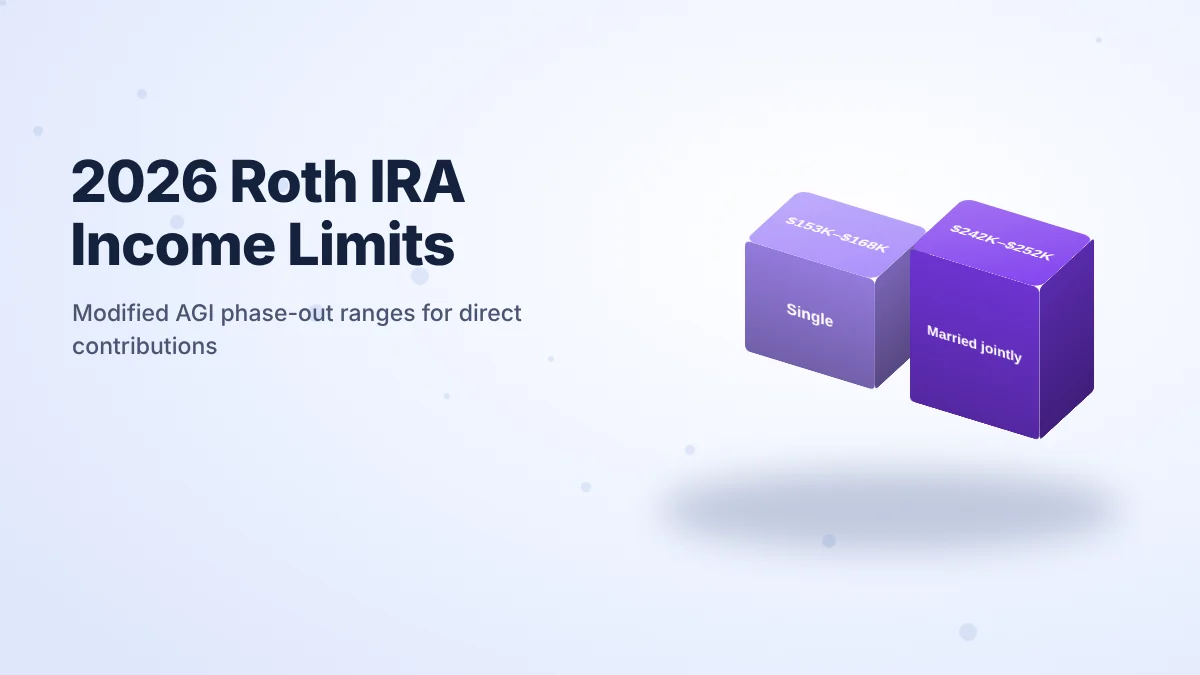
| Filing status | Full contribution if MAGI is under | Phase-out range | No contribution at or above |
|---|---|---|---|
| Single / head of household | $153,000 | $153,000–$168,000 | $168,000 |
| Married filing jointly | $242,000 | $242,000–$252,000 | $252,000 |
| Married filing separately | — | $0–$10,000 | $10,000 |
Inside the phase-out range, your limit shrinks in proportion to how far into the range you are, rounded up to the next $10, with a $200 minimum. A single filer with $160,500 MAGI is halfway through the range, so their limit is $3,750. Our Roth IRA calculator does this math for you.
Roth IRA vs Traditional IRA
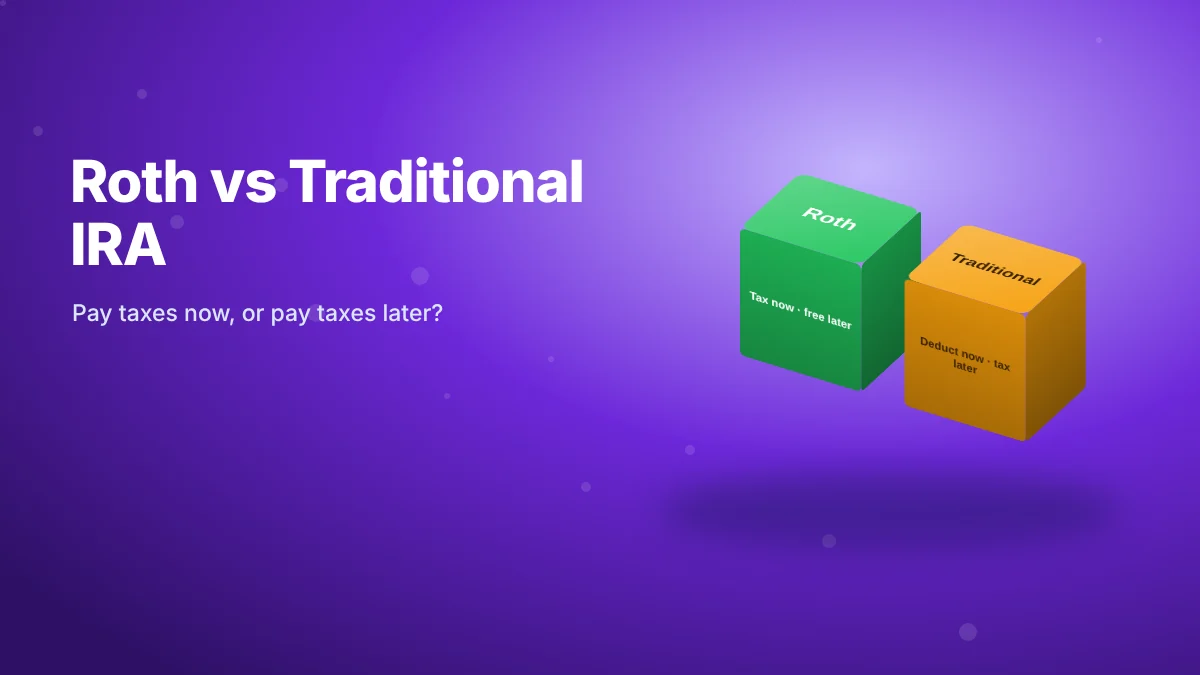
| Roth IRA | Traditional IRA | |
|---|---|---|
| Tax break | Tax-free withdrawals in retirement | Possible tax deduction today |
| Income limit to contribute | Yes (see above) | No, but the deduction may be limited |
| Required minimum distributions | None for the original owner | Yes, generally from age 73 |
| Withdraw contributions early | Anytime, tax- and penalty-free | Taxed, plus 10% penalty before 59½ |
Our Roth IRA calculator can’t decide this for you, but a Roth usually makes the most sense when you expect to be in the same or a higher tax bracket in retirement, which is common for younger savers early in their careers.
Why Starting Early Matters
Investing $7,500 a year from age 25 to 65 at 6% grows to about $1.16 million. Start at 35 and you’d have about $593,000. Those 10 extra years of contributions (only $75,000 more) nearly double the result. Try it in the Roth IRA calculator by changing your current age.
Key Roth IRA Withdrawal Rules
- Contributions can be withdrawn at any time without tax or penalty.
- Earnings are tax-free once you’re 59½ and the account has been open five years.
- Exceptions to the 10% penalty include a first-time home purchase (up to $10,000), disability and certain education costs.
- Conversions from traditional IRAs or 401(k)s have their own five-year clock.
Also saving at work? Model your workplace plan with our 401(k) retirement calculator, and see how compounding works over time with our compound interest tool.
Disclaimer: this Roth IRA calculator is for educational purposes. Projections assume a constant return and the 2026 limits, and the taxable-account comparison is a simplified estimate. This is not tax or investment advice, so consult a qualified professional about your situation.
Roth IRA Calculator FAQs
How much can I put in a Roth IRA in 2026?
Up to $7,500, or $8,600 if you’re 50 or older, as long as you have enough earned income and your modified AGI is under the phase-out limits.
What are the Roth IRA income limits for 2026?
Single filers phase out between $153,000 and $168,000 of MAGI. Married couples filing jointly phase out between $242,000 and $252,000.
How much will my Roth IRA be worth?
It depends on your contributions, time and returns. Enter your numbers in the Roth IRA calculator above to see a year-by-year projection.
Is the Roth IRA calculator accurate?
It uses the official 2026 IRS limits and phase-out rules. Growth projections depend on the return you enter, and real returns vary from year to year.
Can I have a Roth IRA and a 401(k)?
Yes. Workplace plan coverage doesn’t affect your ability to contribute to a Roth IRA. Only your income does.
What if my income is too high for a Roth IRA?
Some people make a nondeductible traditional IRA contribution and convert it to a Roth, known as a “backdoor Roth.” Tax rules like the pro-rata rule apply, so talk to a tax professional first.