
Compound Interest Calculator
See how your money can grow. Enter a starting balance, monthly contribution, interest rate and time, and this compound interest calculator shows your future balance, total interest earned and a year-by-year growth chart.
Calculate your future balance
Year-by-year table
| Year | Contributions | Interest | Balance |
|---|
How to Use This Compound Interest Calculator
- Initial deposit: the money you’re starting with today.
- Monthly contribution: how much you’ll add each month. Enter 0 for a one-time deposit.
- Annual interest rate: the APR or expected annual return. High-yield savings accounts, CDs and long-run stock market averages all differ, so use a realistic number.
- Years and compound frequency: daily, monthly, quarterly or annually, matching your account’s terms.
The compound interest calculator updates live, showing your future balance, how much came from your own deposits versus interest, a year-by-year chart and a full table.
What Is Compound Interest?
Before you use any compound interest calculator, it helps to understand what it’s actually measuring.
Compound interest is interest earned on both your original money and the interest it has already earned. Simple interest only pays on the original deposit. Compounding pays “interest on interest,” so growth speeds up the longer you wait. Albert Einstein may never have actually called it the eighth wonder of the world, but the math earns the nickname.
| $10,000 at 7% for 20 years | Ending balance |
|---|---|
| Simple interest | $24,000 |
| Compounded annually | $38,697 |
Same deposit, same rate, but compounding adds more than $14,000 extra. A compound interest calculator makes that gap easy to see.
Compound Interest Formula
- A = final amount
- P = principal (starting deposit)
- r = annual interest rate as a decimal (7% = 0.07)
- n = times interest compounds per year (12 for monthly, 365 for daily)
- t = years
Example: $5,000 at 5% compounded monthly for 10 years: 5,000 × (1 + 0.05/12)120 = $8,235. When you add regular deposits, each contribution compounds from the month it’s made. That’s why this compound interest calculator simulates every month rather than using one formula.
Daily vs Monthly vs Annual Compounding
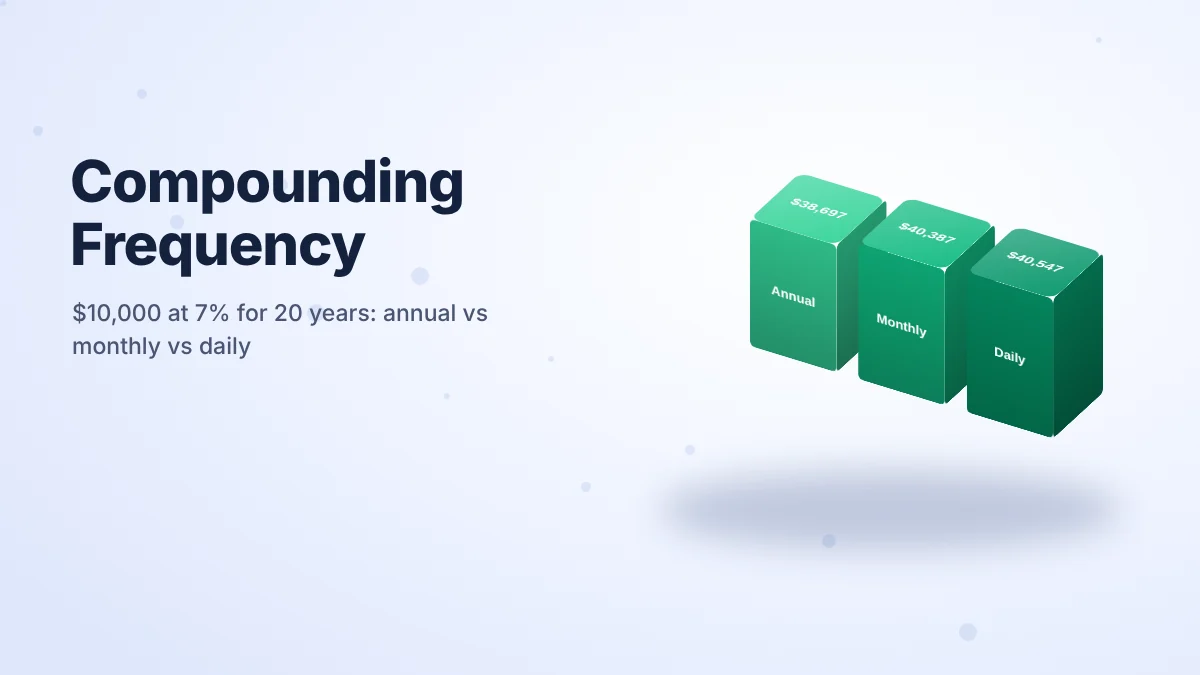
The more often interest compounds, the more you earn, but the difference shrinks quickly:
| Compounding | $10,000 at 7% after 20 years |
|---|---|
| Annually | $38,697 |
| Quarterly | $40,064 |
| Monthly | $40,387 |
| Daily | $40,547 |
Going from annual to monthly adds about $1,700, but daily only adds another $160 or so. Use the daily compound interest calculator setting for high-yield savings accounts, which typically compound daily and pay monthly. For most CDs and loans, monthly compounding is the norm.
APR vs APY
APR is the stated annual rate. APY (annual percentage yield) includes the effect of compounding, so it’s always equal to or higher than APR. A 5% APR compounded daily equals about a 5.13% APY. When comparing savings accounts, compare APYs.
The Rule of 72: A Quick Mental Shortcut
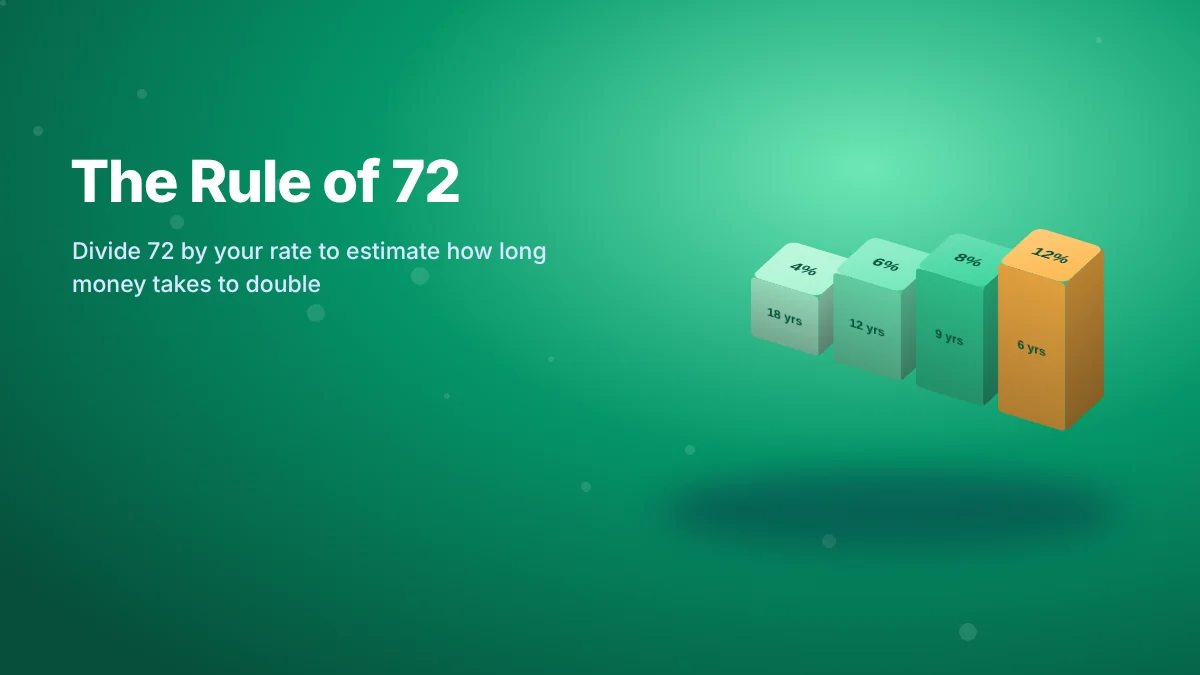
Divide 72 by your annual interest rate to estimate how many years it takes to double your money. At 6%, that’s 72 ÷ 6 = 12 years. At 9%, about 8 years. The calculator above shows both the exact doubling time and the Rule of 72 estimate.
Why Regular Contributions Matter So Much
Starting with $10,000 at 7% for 20 years gives about $40,400 with monthly compounding. Add just $200 a month and the balance jumps to roughly $144,600. You’d contribute $58,000 total and earn more than $86,000 in interest. Time and consistency usually matter more than finding a slightly higher rate. Try changing the contribution in the compound interest calculator to see the effect for yourself.
Start early
Each extra year gives every dollar more time to compound.
Automate deposits
Schedule transfers on payday so saving happens without thinking.
Watch fees and taxes
A 1% annual fee can quietly eat a big share of long-term growth.
Compound Interest Works Against You on Debt
The same math that grows savings also grows credit card balances, and you can model debt in a compound interest calculator too. A $3,000 balance at 24% APR left alone would roughly double in about three years. If you carry high-interest debt, paying it down is often the best “return” available.
Disclaimer: this compound interest calculator is for educational purposes only. Results assume a constant rate, and real investment returns vary and can be negative. It doesn’t account for taxes, fees or inflation. This is not financial advice, so consider speaking with a licensed financial professional.
Compound Interest Calculator FAQs
How do I calculate compound interest?
Use A = P(1 + r/n)^(nt), where P is the principal, r is the annual rate as a decimal, n is how many times interest compounds per year, and t is years. Subtract P from A to get the interest earned.
Is this compound interest calculator free?
Yes. It’s free, needs no sign-up, and every calculation runs in your browser.
Is daily or monthly compounding better?
Daily compounding earns slightly more, but the difference from monthly is small. On $10,000 at 7% for 20 years, it’s about $160.
How much will $10,000 grow in 10 years?
At 7% compounded monthly with no extra deposits, about $20,097. At 5%, about $16,470. Use the calculator to try your own rate.
What is a realistic interest rate to use?
High-yield savings and CD rates change with the economy, so check current offers. Long-term stock market returns have historically averaged more, but they swing a lot from year to year and are never guaranteed.
Does the calculator include inflation and taxes?
No. Results are before taxes and inflation. To see what your money will be worth in today’s dollars, subtract the expected inflation rate from your interest rate.