
Peptide Calculator: Reconstitution and Syringe Units
Enter the amount of peptide in your vial, the volume of diluent added and the dose your prescriber gave you. This peptide calculator works out the concentration, how many units to draw on a U-100 insulin syringe, and how many doses the vial contains.
Enter your numbers
Important safety notice: this peptide calculator is a math tool only. It does not recommend doses, products or protocols. Many peptides sold online are labeled “for research use only” and are not approved by the FDA for human use. Only use injectable medications prescribed by a licensed healthcare provider and dispensed by a licensed pharmacy, and always confirm your measurements with your pharmacist.
How to Use the Peptide Calculator
- Peptide in vial: the total amount printed on the vial label, usually in milligrams (mg).
- Diluent added: the volume of bacteriostatic or sterile water your pharmacist or prescriber told you to add, in milliliters (mL).
- Prescribed dose: the amount you were told to take, in micrograms (mcg) or milligrams (mg).
- Syringe: the capacity of your U-100 insulin syringe.
The peptide calculator then shows the concentration, the exact number of units to draw, a visual syringe fill line and how many doses the vial holds.
How Peptide Reconstitution Math Works
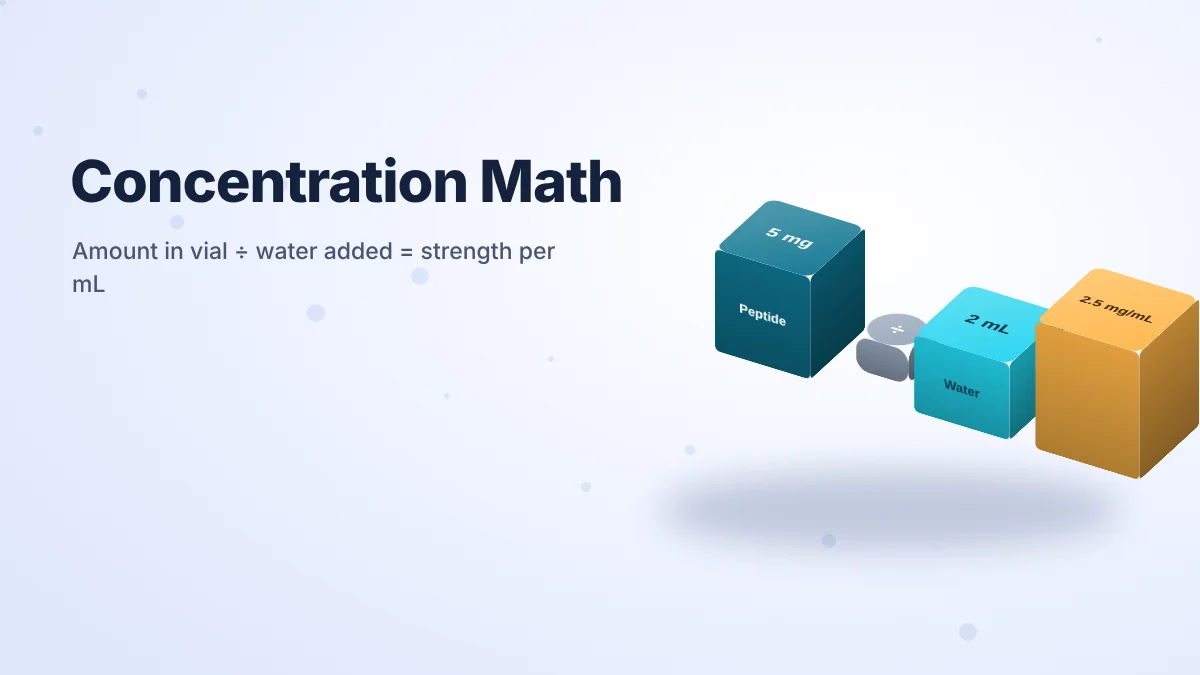
Lyophilized (freeze-dried) peptides come as a powder. Adding liquid (“reconstitution”) turns that powder into a solution with a known strength:
Worked example: a 5 mg vial with 2 mL of water gives 2.5 mg/mL (2,500 mcg/mL). For a 250 mcg dose: 250 ÷ 2,500 = 0.1 mL = 10 units. The vial contains 5,000 ÷ 250 = 20 doses. Every number here can be checked in the peptide reconstitution calculator above.
Adding more liquid makes the solution weaker, so each dose takes more units. Less liquid makes it stronger and each dose smaller. The amount of drug per dose doesn’t change, only the volume you draw.
Understanding Insulin Syringe Units
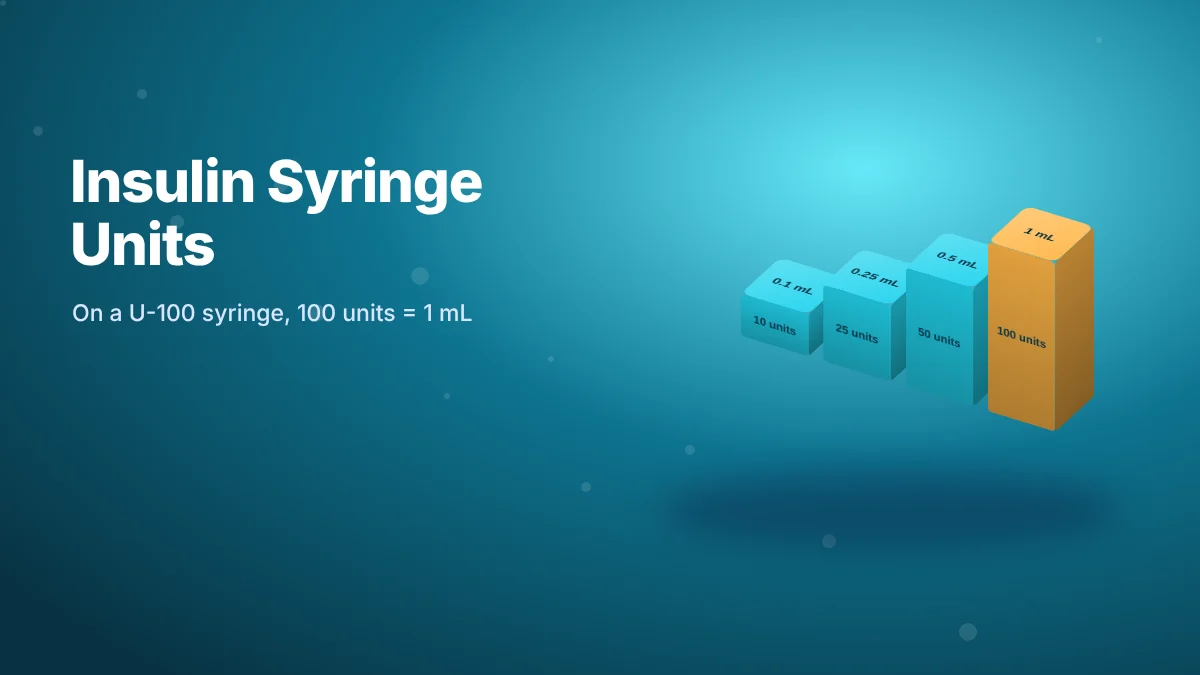
U-100 insulin syringes are marked in “units,” where 100 units = 1 mL. Units here are just a volume marking. They don’t mean the same thing as units of insulin activity for other medicines.
| Syringe units | Volume |
|---|---|
| 1 unit | 0.01 mL |
| 5 units | 0.05 mL |
| 10 units | 0.10 mL |
| 25 units | 0.25 mL |
| 50 units | 0.50 mL |
| 100 units | 1.00 mL |
Smaller syringes, such as 0.3 mL (30 units), have finer markings and make small doses easier to measure accurately.
mg and mcg Conversions
- 1 milligram (mg) = 1,000 micrograms (mcg)
- 0.25 mg = 250 mcg
- 0.1 mg = 100 mcg
Mixing up mg and mcg is the most dangerous dosing error: it’s a 1,000-fold difference. The dose unit selector in our peptide dosage calculator helps prevent that mistake.
Safety Checklist
- Use only medications prescribed to you and dispensed by a licensed pharmacy.
- Have your pharmacist confirm the reconstitution volume and your units.
- Follow your pharmacist’s directions for sterile technique, storage and how long the reconstituted vial stays usable.
- Never share needles or syringes, and dispose of sharps in an approved container.
- Seek medical help for unusual reactions.
Tracking nutrition alongside a treatment plan? See our macro calculator for daily protein, carb and fat targets.
Peptide Calculator FAQs
How do you use a peptide calculator?
Enter the vial amount in mg, the volume of liquid added in mL and your prescribed dose. The calculator returns the concentration and the number of units to draw on a U-100 syringe.
How much bacteriostatic water should I add?
Follow the instructions from your prescriber or pharmacist. The calculator shows how different volumes change the concentration and units per dose, but it doesn’t recommend a volume.
How many units is 250 mcg?
It depends on concentration. With 5 mg in 2 mL (2,500 mcg/mL), 250 mcg is 0.1 mL, or 10 units on a U-100 syringe.
How many doses are in my vial?
Divide the total amount in the vial by your dose, using the same units. A 5 mg vial at 250 mcg per dose holds 20 doses.
Does this peptide calculator give dosing advice?
No. It only performs unit conversions and arithmetic. Dosing decisions must come from a licensed healthcare provider.